
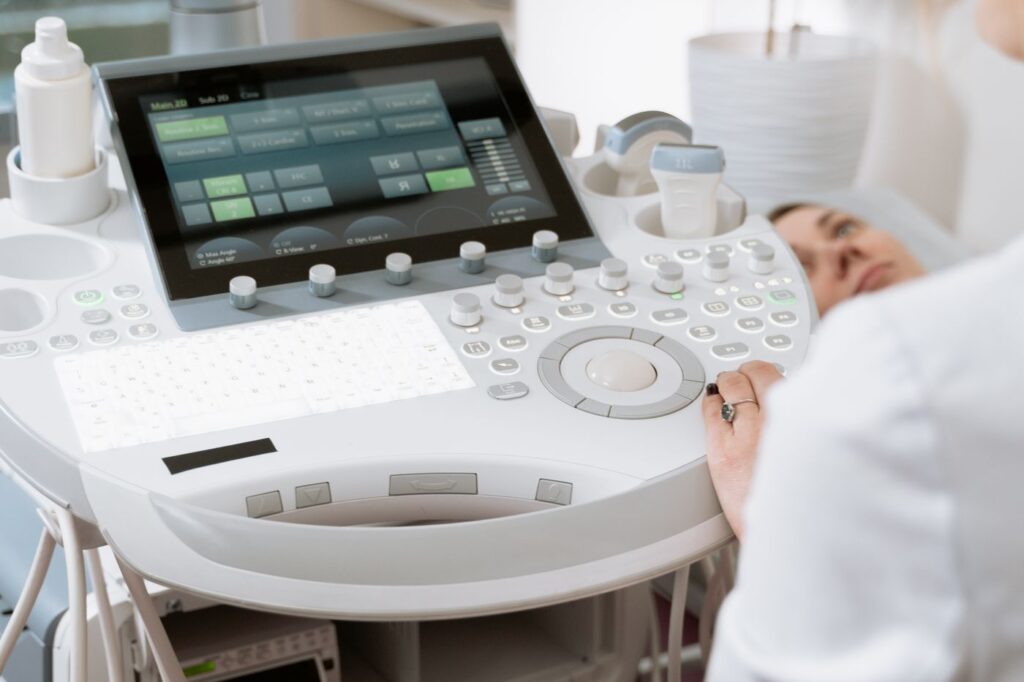
Renal Ultrasound and Imaging
Sometimes the best way to understand what’s going on with your kidneys is to simply take a look. We offer in-house ultrasound imaging — a painless, radiation-free scan — right here at our Winter Garden office, so you don’t have to drive somewhere else and wait days for answers. We can image your kidneys, blood vessels, and more, and we’ll take the time to explain what we see in plain language.
Ultrasound is one of the most common and gentle ways to look inside the body. It uses a small handheld device called a transducer that sends safe, painless sound waves into the body and listens for the echoes to build a picture on a screen. There is no radiation and no anesthesia, so most people can go straight back to their normal day afterward.
A kidney (renal) ultrasound lets the care team see the size, shape, and position of your kidneys and nearby structures such as the bladder. It can help show problems like kidney stones, cysts, tumors, signs of injury, or a possible blockage. Because it is noninvasive and uses no radiation, it is often one of the first imaging tests a nephrologist reaches for, and it can be repeated safely over time to follow a condition.
Doppler ultrasound adds another layer: instead of just showing structures, it measures how blood is moving through a vessel. This is how the team can study the arteries and veins in your arms, legs, or neck, look at blood flow to your kidneys, and map veins before dialysis-access surgery. The same technology is used to look at the carotid arteries in the neck and to examine the parathyroid glands near the thyroid, which help regulate calcium and are often affected in kidney disease. Imaging like this helps your physician understand what is happening, but it is one piece of the picture, used alongside your history, exam, and lab work.
What we offer
- Renal (kidney) ultrasound — An in-house, radiation-free scan of your kidneys and nearby structures to help evaluate kidney size and shape, stones, cysts, or a possible blockage.
- Dialysis access and vein mapping — Ultrasound mapping of the arteries and veins in your arm to help plan and follow up on dialysis access, so surgery can be planned with a clearer picture of your vessels.
- Venous and arterial Doppler — Blood-flow studies of the veins and arteries in your arms or legs to look for narrowing, reduced circulation, or poorly working vein valves.
- Carotid ultrasound — An exam of the carotid arteries in the neck that carry blood to the brain, using Doppler to look at both the vessel walls and the blood flow for narrowing or plaque.
- Parathyroid ultrasound — Neck ultrasound used to help look at the parathyroid glands, which help control calcium balance that is often affected in kidney disease.
- In-house convenience — These studies are performed right here in our office, so you can often avoid a separate trip to an imaging center.
What to expect
For most ultrasound exams, little or no special preparation is needed, though for some kidney or bladder scans you may be asked to drink water beforehand or to avoid eating for a few hours, and the office will tell you in advance. You will lie comfortably on an exam table while a technologist applies gel to the skin over the area being studied, then glides the smooth transducer across it to capture images. The exam is painless and a typical scan takes roughly 20 to 30 minutes, though this varies by study. For neck and arm studies, loose, comfortable clothing helps. Afterward, your nephrologist reviews the images and discusses what they mean for your care.
Why choose West Orange Nephrology?
Convenient care
renal ultrasound, dialysis access and vein mapping, venous and arterial Doppler, and carotid and parathyroid ultrasound are all performed in-house, often saving you a separate trip to an outside imaging center.
Caring approach
our exams are noninvasive and painless, and our team takes time to explain what each study is for and what we see, in keeping with our mission to empower you with information.
Collaborative care
because Dr. Banji Awosika and our nephrologists and nurse practitioners both order and review your imaging, results connect directly to your kidney care across our office, hospitals, dialysis centers, and telehealth.
Frequently asked questions
Does a kidney ultrasound hurt or use radiation?
No. Ultrasound is noninvasive and painless, and it does not use radiation. It works by bouncing safe sound waves off your organs to create a picture, so it can be repeated safely when needed.
How should I prepare for my ultrasound?
Preparation depends on the type of exam. Some kidney or bladder scans ask you to drink water beforehand, and a few studies may ask you not to eat for a few hours. Our office will give you specific instructions when your appointment is scheduled.
What is vein mapping for dialysis access?
Vein mapping is an ultrasound study of the arteries and veins in your arm. It helps your care team and surgeon understand your blood vessels when planning dialysis access. Whether it is recommended depends on your individual situation, which your physician will discuss with you.
Will I get my results the same day?
Your nephrologist reviews the images and talks with you about what they show. Some findings can be discussed soon after the scan, while others are reviewed alongside your labs and history before next steps are decided.
