
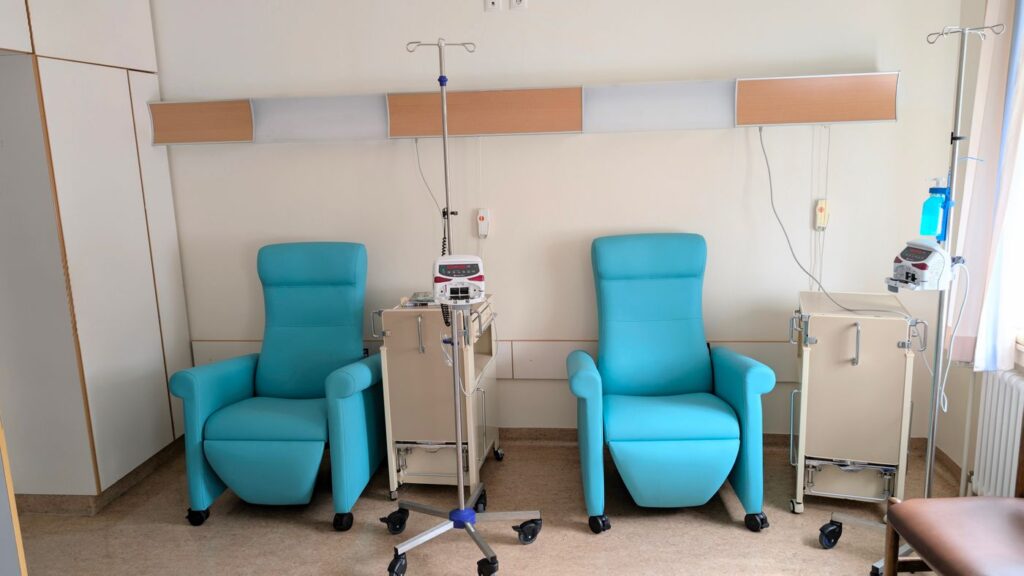
Dialysis Care
Hearing that you may need dialysis — a treatment that takes over the kidney’s job of filtering waste and fluid from your blood — can feel overwhelming. But there’s more than one way to do dialysis, and the right fit depends on your body, your schedule, and your goals. Our team will walk you through your options, help you understand the difference, and stay by your side from your very first treatment onward.
Healthy kidneys filter waste and extra fluid from your blood, balance important minerals, and help control blood pressure. When kidney disease advances to kidney failure, your kidneys can no longer keep up, and dialysis is one of the treatments that can do part of that job for them. Dialysis does not cure kidney disease and replaces only part of your kidney function, but it removes wastes and extra fluid that build up in your body and can help you feel better and keep doing the things you enjoy.
There are two main types of dialysis. Hemodialysis uses a machine and a special filter to clean your blood outside your body, then returns it to you. Peritoneal dialysis uses the lining of your own belly, along with a cleansing fluid, to filter your blood from the inside, and it is done at home — either with several exchanges spread through the day or with a machine that does the exchanges overnight while you sleep. Hemodialysis can be done at a dialysis center, usually about three times a week for about four hours each session, or at home, where more frequent treatments are possible.
There is no single "best" choice — the right treatment depends on your health, your daily routine, your support at home, and what matters most to you. Learning about your options early, ideally before you need to start, gives you time to prepare, ask questions, and involve the people who care about you.
What we offer
- In-center hemodialysis — Our nephrologists round at local dialysis centers, so you receive your in-center hemodialysis treatments with trained staff close by and your kidney doctor staying closely involved in your care.
- Peritoneal dialysis — We support peritoneal dialysis, a home-based option that uses the lining of your belly to filter your blood — done either as exchanges through the day or overnight by machine — for more flexibility and independence in your daily routine.
- Home hemodialysis — For patients who are good candidates, we offer guidance on home hemodialysis, which can allow more frequent treatments and a schedule that fits around your life and family.
- Pre-dialysis education — Before dialysis is ever needed, our team takes time to explain all of your options so you and your loved ones can make an informed, unhurried choice that fits your goals.
What to expect
At your visit, your nephrologist will review your kidney function, overall health, and lifestyle, then walk you through the dialysis options in plain language. If dialysis is approaching, this is the time to discuss treatment type and planning for access — such as a fistula for hemodialysis or a soft catheter in the belly for peritoneal dialysis. Access is created ahead of time so it is ready when you need it: a hemodialysis fistula usually needs time to heal and mature before it can be used, while a peritoneal dialysis catheter works best with a couple of weeks to settle before a full schedule begins. Our team rounds at local dialysis centers and stays connected through office visits and telehealth, so your care is coordinated whether you dialyze in a center or at home. Please call 407-297-8408 to schedule.
Why choose West Orange Nephrology?
Convenient care
Our nephrologists round at local dialysis centers and connect through office visits and telehealth, so your dialysis care is coordinated close to home — in a center or at home itself.
Caring approach
We take time to explain every option in plain language before you ever need to start, so you and your loved ones can make an unhurried, informed choice that fits your life.
Collaborative care
From pre-dialysis education through in-center, peritoneal, or home dialysis, your nephrologist and care team stay closely involved and work alongside the dialysis center staff on your behalf.
Frequently asked questions
What is the difference between hemodialysis and peritoneal dialysis?
Hemodialysis uses a machine and a filter to clean your blood outside your body and is often done at a center about three times a week, for around four hours a session, or at home. Peritoneal dialysis uses the lining of your belly and a cleansing fluid to filter your blood from the inside, and is done at home — either with several exchanges during the day or overnight by machine while you sleep. Your nephrologist can help you weigh which fits your health and lifestyle.
Can I really do dialysis at home?
For many people, yes. Both peritoneal dialysis and home hemodialysis can be done at home after training, and they can offer more flexibility, more independence, and often fewer dietary restrictions than in-center treatment. Home options aren't right for everyone, so we'll talk through whether you're a good candidate.
What is a dialysis access and why do I need one set up early?
An access is the way dialysis connects to your body. For hemodialysis it is often a fistula — an artery and vein joined under the skin — which needs time to heal and grow stronger before it's ready to use. For peritoneal dialysis it is a soft catheter placed in the belly. Planning ahead means your access is ready when you need it.
Does dialysis cure kidney failure?
No. Dialysis replaces part of the work your kidneys did and can help you feel better, but it is not a cure. It is one of several treatment paths for kidney failure, and our team will help you understand all of your options.
